
- Home
- Company Overview
Company Overview
Unlock your digital potential with Kalgisoft — where innovation meets execution.
Inner Pages
A women led Innovating technology solutions provider that empower businesses to grow and succeed.KalgiSoft approaches every client’s business as if it were our own.Dedicated experts delivering innovative solutions with passion, skill, and integrityReal stories from clients reflecting our impact, innovation, and excellence.Empowering careers with growth opportunities, innovation, and a collaborative cultureCompany Overview
Unlock your digital potential with Kalgisoft — where innovation meets execution.Inner Pages
A women led Innovating technology solutions provider that empower businesses to grow and succeed.KalgiSoft approaches every client’s business as if it were our own.Dedicated experts delivering innovative solutions with passion, skill, and integrityReal stories from clients reflecting our impact, innovation, and excellence.Collaborating with trusted partners to deliver innovative, high-quality business solutions.Empowering careers with growth opportunities, innovation, and a collaborative culture
- Technical Services
- Recruitment Services
- Contact Us

- Home
- Company Overview
Company Overview
Unlock your digital potential with Kalgisoft — where innovation meets execution.Inner Pages
A women led Innovating technology solutions provider that empower businesses to grow and succeed.KalgiSoft approaches every client’s business as if it were our own.Dedicated experts delivering innovative solutions with passion, skill, and integrityReal stories from clients reflecting our impact, innovation, and excellence.Empowering careers with growth opportunities, innovation, and a collaborative cultureCompany Overview
Unlock your digital potential with Kalgisoft — where innovation meets execution.Inner Pages
A women led Innovating technology solutions provider that empower businesses to grow and succeed.KalgiSoft approaches every client’s business as if it were our own.Dedicated experts delivering innovative solutions with passion, skill, and integrityReal stories from clients reflecting our impact, innovation, and excellence.Collaborating with trusted partners to deliver innovative, high-quality business solutions.Empowering careers with growth opportunities, innovation, and a collaborative culture
- Technical Services
- Recruitment Services
- Contact Us
Project Management: The Complete Guide for Every Team
Every successful business outcome starts with a project. And every successful project starts with effective Project Management : the discipline of turning ideas into results within defined constraints of scope, time, and budget.
The Standish Group’s Chaos Report consistently finds that projects with strong project management practices are 2.5x more likely to succeed than those without. Yet the same research shows that only 35% of projects are completed on time and on budget. The gap between successful and failed projects is almost never about talent — it is about process, methodology, and tools.
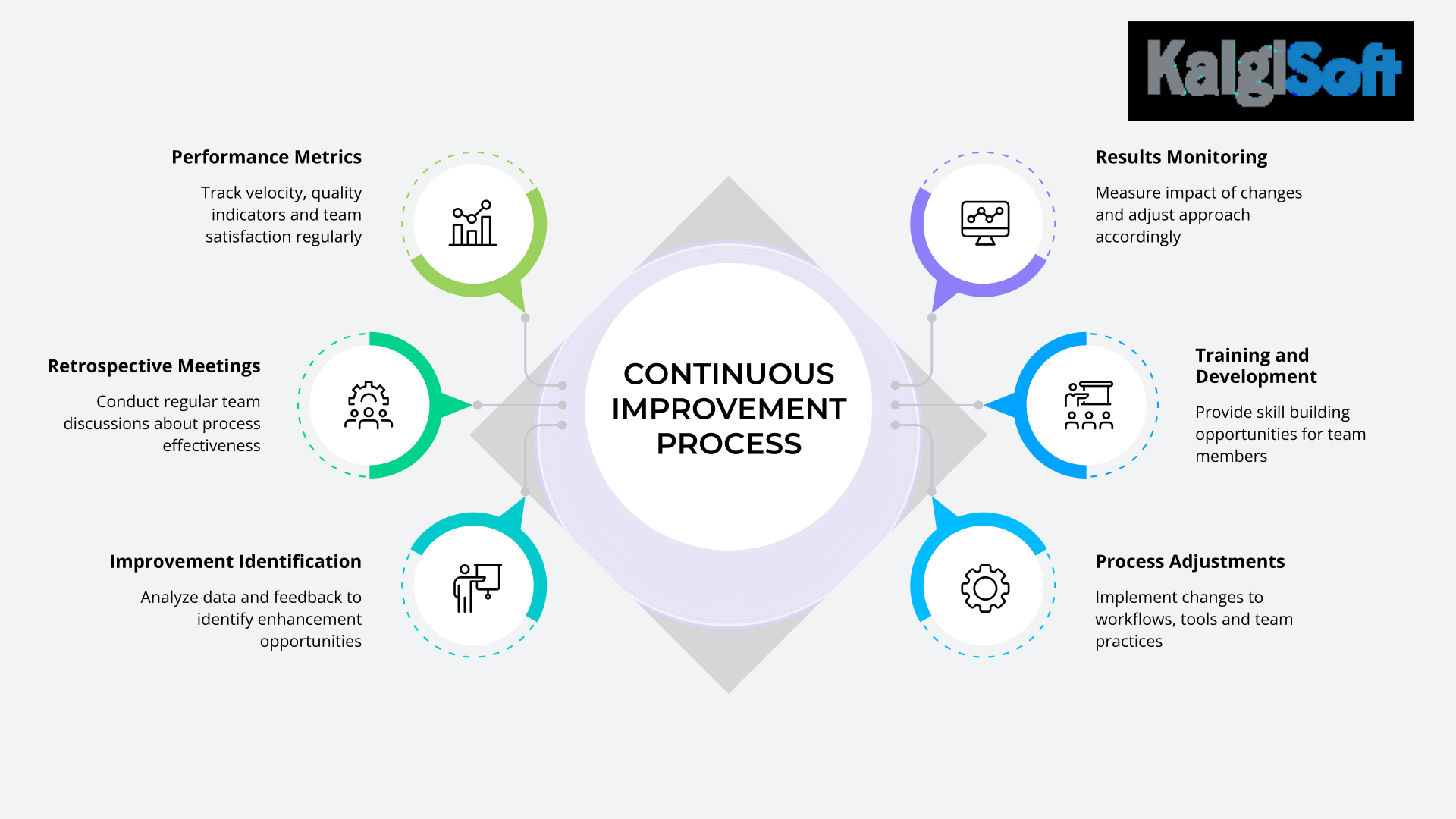
What Is Project Managment ?
Build Apps Once, Deploy Everywhere With React Native And Flutter.
Project management is the structured application of knowledge, skills, tools, and techniques to project activities in order to meet project requirements. A project is a temporary endeavour — it has a defined start and end — undertaken to create a unique product, service, or result.
your trusted partner in Agile and Waterfall Project Management.
Empower your business with Kalgisoft
Agile Project Management
Deliver projects with flexibility, adaptability, and continuous collaboration, ensuring faster outcomes that align with evolving business needs.
Waterfall Project Management
Structured, step-by-step execution with clear milestones, detailed planning, and predictable results for projects requiring strict process control.
End-to-End Delivery
From initiation to closure, we manage the entire project lifecycle with transparency, efficiency, and measurable business outcomes.
Risk & Resource Optimization
identify potential risks early, optimize resources, and ensure maximum value from time, budget, and team capabilities.
Tailored Methodologies
Choose Agile, Waterfall, or hybrid models—customized to your business goals, ensuring projects align with your unique requirements.
FAQ's
What is the difference between Agile and Waterfall project management?
Waterfall is sequential: each phase (requirements, design, build, test, deploy) must be fully completed before the next begins. It works best when requirements are fixed, stable, and fully known upfront — common in construction, manufacturing, and regulated industries. Agile is iterative: work is broken into short cycles (sprints) that each deliver working output, allowing requirements to evolve based on feedback. Agile is the standard for software, digital product development, and any project where requirements are likely to change. Most modern enterprise teams use a hybrid: Waterfall structure for milestones, Agile for delivery within each phase.
What is the best project management software for a small team?
For small teams (under 15 people): Trello is the easiest to set up and has the best free tier for simple Kanban boards. Asana offers more structure and automation while remaining accessible. ClickUp gives the most features per dollar — tasks, docs, goals, and time tracking in one tool. Monday.com is the most visually intuitive option for non-technical teams. For software development teams specifically, Jira (free up to 10 users) and Linear are purpose-built for Agile sprints and issue tracking.
What is the difference between project management and program management?
A project is a temporary, bounded endeavour to deliver a specific output. A program is a group of related projects managed in a coordinated way to achieve benefits that could not be obtained by managing each project independently. Portfolio management is the highest level — governing all projects and programs to ensure alignment with strategic business objectives. Most organisations have projects managed by project managers, programs managed by program managers, and portfolios overseen by a PMO (Project Management Office) or executive leadership.
Can Agile project management work for non-technical teams?
Yes — agile project management for non-technical teams works very effectively when the jargon is simplified and the framework is adapted. Marketing teams use sprints to ship campaigns. HR teams use Kanban boards to track hiring pipelines. Operations teams use retrospectives to continuously improve processes. The key adaptations for non-tech teams: replace 'story points' with time estimates, use visual Kanban boards instead of complex sprint tools, keep retrospectives to 30 minutes with 3 questions (what worked, what didn't, what to change), and use Monday.com or Trello rather than Jira.